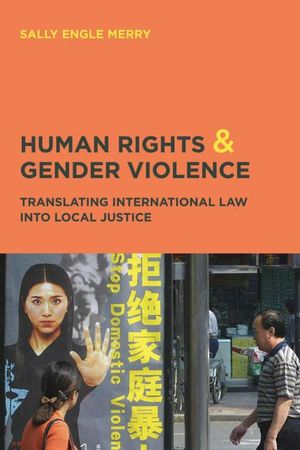

Human Rights & Gender Violence


Published by The University of Chicago Press
“An extraordinary account of the complex articulations of bureaucracy, policy, and local culture around the issue of violence against women. . . . A convincing argument for taking seriously the notion of local cultures and provides a model for how context, translation, values, and the particulars of social and institutional life can be given consideration.” —Donald Brenneis, University of California, Santa Cruz
Human rights law and the legal protection of women from violence are still fairly new concepts. As a result, substantial discrepancies exist between what is decided in the halls of the United Nations and what women experience daily in their communities. Human Rights and Gender Violence is an ambitious study that investigates the tensions between global law and local justice.
As an observer of UN diplomatic negotiations as well as the workings of grassroots feminist organizations in several countries, Sally Engle Merry offers an insider's perspective on how human rights law holds authorities accountable for the protection of citizens even while reinforcing and expanding state power. Providing legal and anthropological perspectives, Merry contends that human rights law must be framed in local terms to be accepted and effective in altering existing social hierarchies. Gender violence in particular, she argues, is rooted in deep cultural and religious beliefs, so change is often vehemently resisted by the communities perpetrating the acts of aggression.
A much-needed exploration of how local cultures appropriate and enact international human rights law, this book will be of enormous value to students of gender studies and anthropology alike.
“A book that should be read by every sociologist interested in globalization, international law, or human rights.” —American Journal of Sociology
“A valuable contribution to our thinking about international human rights, both because it examines in empirical detail the interaction between the transnational culture of human rights and alternative cultural discourses in specific contexts and because it acts as a corrective to oversimplified assumptions about the meaning of international human rights and the meaning of culture.” —Ethics and International Affairs
“Merry provides an excellent model of how to conduct multi-sited fieldwork in a de-territorialized world, demonstrating how ethnography permits engagement with the fragments of a larger global system. . . . Wonderfully clear and engaging writing.” —Canadian Review of Sociology and Anthropology
BUY NOW FROM

COMMUNITY REVIEWS

