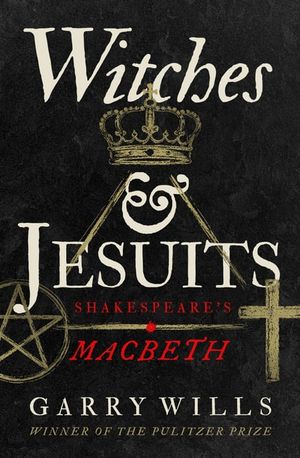

Witches & Jesuits


Published by Open Road Media
The Pulitzer Prize–winning author of Lincoln at Gettysburg interprets Shakespeare’s 1606 play Macbeth through the lens of England’s Gunpowder Plot of 1605.
“A lively and provocative read. As a writer, Mr. Wills possesses the qualities of a fine teacher. . . . In these pages, he’s able to use those gifts to make Macbeth come alive as a play.” —The New York Times
If William Shakespeare’s Macbeth is such a great tragedy, why do performances of it so often fail? The drama is often referred to as “the Scottish play” by superstitious actors due to its legendary curse. But that’s not Macbeth’s only trouble. Its action flies by in the beginning only to stumble in the final two acts. Critical consensus when this book was first published in 1995 says that there was only one successful modern stage performance of the play by Laurence Olivier in 1955. Although Olivier’s staging was a success, even he couldn’t make the fourth and fifth acts interesting. The problem lies, author Garry Wills believes, not in Shakespeare’s play, but in ourselves.
In Witches and Jesuits, Wills argues that Macbeth is best experienced after understanding what was in the zeitgeist when the play premiered in the early seventeenth century. Drawing on his knowledge of the intrigue and drama of Jacobean England, Wills examines the Gunpowder Plot of 1605, when a small cell of Jesuits conspired to blow up the King, his heir, and all the members of court and Parliament—and almost succeeded. 1606 audiences would have been shocked by the crime much in the same way Americans endured the attack on Pearl Harbor or the JFK assassination. The first audience would also believe the Jesuits were linked to witchcraft, prevalent at the time due to King James I’s recent addition to the country’s Witchcraft Acts. There was a decree of death for those who procured “the skin, bone, or any other part of any dead person—to be employed or used in any manner of witchcraft, sorcery, charm, or enchantment.” The treason and necromancy in Macbeth were more than a gifted playwright’s imagination at work; they were dramatizations of very real threats to England.
With Witches and Jesuits, Wills places Macbeth in the proper light. When we “remember, remember the fifth of November,” the characters, the story, and the experience of the play transform into something better. Wills restores the theological politics and supernatural elements that modern directors had shied away from. In doing so, Wills provides an insightful read that could help Macbeth escape the curse of “the Scottish play.”
“Absorbing . . . logical and creative. . . . Fresh and provocative.” —The Boston Globe
“[Wills] impresses the reader with the historical perspective and rich allusiveness that characterize his other writing.” —The Washington Post Book World
“Highly readable and informative.” —Houston Chronicle
BUY NOW FROM

COMMUNITY REVIEWS

