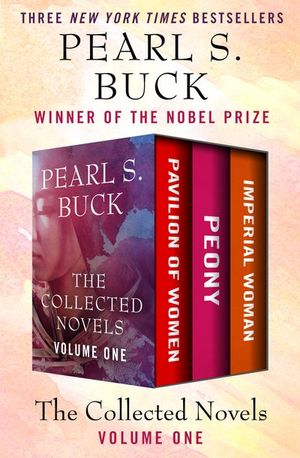

The Collected Novels Volume One


Published by Open Road Media
Three New York Times bestsellers from the author of The Good Earth: These three novels are fascinating portraits of women in China.
In 1938, Pearl S. Buck became the first woman to win a Nobel Prize in Literature for The Good Earth, which had already earned her the Pulitzer Prize. The daughter of missionaries, the New York Times–bestselling author would continue to explore many aspects of Chinese culture in her work, and the three novels collected here represent some of her most compassionate and revealing fiction.
Pavilion of Women: After Madame Wu turns forty, she encourages her husband to take a young concubine so she can finally begin to discover her own mind—and a new world opens up before her as she reads forbidden books and studies English with a progressive former priest.
”Beautifully written . . . A fine, full flavorsome novel.” —Newsweek
Peony: A young Chinese bondmaid in nineteenth-century China falls in love with the son of the wealthy Jewish family she works for. As the couple's traditions collide, their relationship faces opposition from every side.
”Peony has the vividness of scene and episode and character and the colorful detail that [Buck's] readers have come to expect of her novels in China.” —New York Herald Tribune
Imperial Woman: The life story of Tzu Hsi, the magnetic and fierce-minded woman who rose from concubine to become the working head of the Qing Dynasty and the last empress of China for nearly half a century.
”Certainly, no fictioneer could imagine a more incredible woman. . . . Pearl Buck has done a remarkable and painstaking job in recreating her.” —Saturday Review
BUY NOW FROM

COMMUNITY REVIEWS

