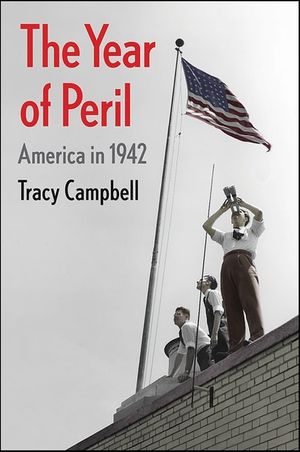

The Year of Peril


“[A] thought-provoking. . . .compelling” chronicle exploring how the character of American society revealed itself during WWII (Paul Kennedy, Wall Street Journal).
Winner of the New-York Historical Society’s Barbara and David Zalaznick Book Prize
The Second World War exists in the American historical imagination as a time of unity and optimism. In 1942, however, after a series of defeats in the Pacific and the struggle to establish a beachhead on the European front, America seemed to be on the brink of defeat and was beginning to splinter from within.
Exploring this precarious moment, Tracy Campbell paints a portrait of the deep social, economic, and political fault lines that pitted factions of citizens against each other in the post–Pearl Harbor era, even as the nation mobilized, government-aided industrial infrastructure blossomed, and parents sent their sons off to war.
This captivating look at how American society responded to the greatest stress experienced since the Civil War reveals the various ways, both good and bad, that the trauma of 1942 forced Americans to redefine their relationship with democracy in ways that continue to affect us today.
“Campbell’s brilliant book should be required reading.” —Nancy Beck Young, Missouri Historical Review
“Tracy Campbell splendidly recreates the era and dispels its myths.” —Donald A. Ritchie, historian emeritus of the U.S. Senate and author of Electing FDR: The New Deal Campaign of 1932
“Campbell’s riveting history reveals our current predicaments to be the same poisons that almost killed America in 1942.” —Timothy B. Tyson, author of The Blood of Emmett Till
BUY NOW FROM

COMMUNITY REVIEWS

