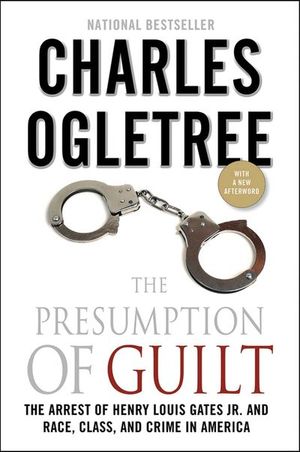

The Presumption of Guilt


Published by St. Martin's Publishing Group
A look at the arrest of an acclaimed Harvard professor and what it says about the state of race relations and civil rights in America.
“Professor Ogletree lifts up voices that have been forgotten. That has been his life’s work. . . . It has been my great honor and a pleasure of my life to have known [him].” —President Barack Obama
Shortly after noon on Tuesday, July 16, 2009, Henry Louis Gates, Jr., MacArthur Fellow and Harvard professor, was mistakenly arrested by Cambridge police sergeant James Crowley for attempting to break into his own home. The ensuing media firestorm ignited debate across the country. The Crowley-Gates incident was a clash of absolutes, underscoring the tension between black and white, police and civilians, and the privileged and less privileged in modern America. Charles Ogletree, one of the country's foremost experts on civil rights, uses this incident as a lens through which to explore issues of race, class, and crime, with the goal of creating a more just legal system for all.Working from years of research and based on his own classes and experiences with law enforcement, the author illuminates the steps needed to embark on the long journey toward racial and legal equality for all Americans.
“Deftly uses the Gates case to advance the dialogue on racial profiling. The author makes a significant and fair-minded contribution to the literature on race, class, and law enforcement.” —The Philadelphia Inquirer
“Ogletree brings an informed opinion regarding Gates’ arrest . . . [and] uses contemporary incidents to explore current notions of race and class… . . . Recommended.”―Choice
“The Presumption of Guilt is both informative and instructive. Informative because it provides a very accurate description of the events of that day and instructive because it identifies the critical areas which must be addressed in order to prevent racial profiling and other disparities in the criminal justice system.” —Ronald E. Hampton, Executive Director, National Black Police Association
BUY NOW FROM

COMMUNITY REVIEWS

