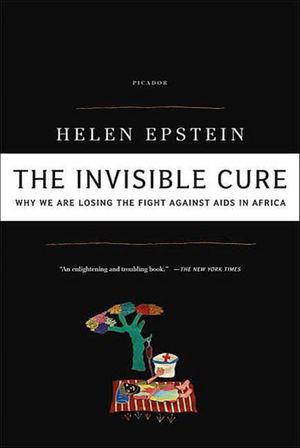

The Invisible Cure


Published by Farrar, Straus and Giroux
New York Times Notable Book: “Enlightening and troubling,” a scientist searching for an AIDS vaccine in Uganda explores Africa's AIDS epidemic (The New York Times).
Helen Epstein left her job in the US in 1993 to move to Uganda, where she began work on a test vaccine for HIV. Once there, she met patients, doctors, politicians, and aid workers, and began exploring the problem of AIDS in Africa through the lenses of medicine, politics, economics, and sociology. Amid the catastrophic failure to reverse the epidemic, she discovered a village-based solution that could prove more effective than any network of government intervention and international aid, an intuitive response that calls into question many of the fundamental assumptions about the AIDS in Africa.
Written with conviction, knowledge, and insight, The Invisible Cure will change how we think about the worst health crisis of the past century—and indeed about every issue of global public health.
“Helen Epstein is one of a rare species: the scientist turned storyteller. . . . [A] blunt, informed critique.” —Salon.com
“Elegant prose, a scientific background, and a journalist's searching anecdotal eye.” —Nature
“Sometimes a bolt of clarity shoots out of the blue . . . as it will for readers of this book who yearn for insights on how a deadly virus now infects an estimated 25 million Africans and has killed untold millions more.” —The New York Times Book Review
“Epstein has a compelling thesis, and she explains it in lucid, sometimes extraordinary prose.” —The Nation
BUY NOW FROM

COMMUNITY REVIEWS

