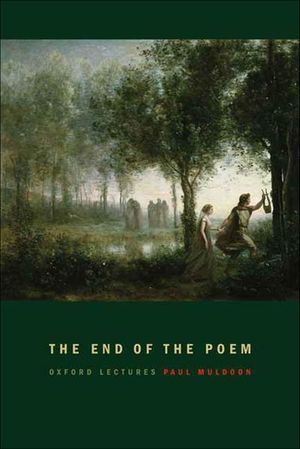

The End of the Poem


Published by Farrar, Straus and Giroux
“Muldoon’s Oxford lectures, The End of the Poem, offer a trenchant and clever analysis of the power of poetry.” —The Guardian, UK
“One of the most impressive books of practical criticism and poetic intelligence I have read in years. It is entertaining, informative, brilliant, distinctive, yet accessible for the common reader.” —Chicago Tribune
In The End of the Poem, Paul Muldoon dazzlingly explores a diverse group of poems, from Yeats’s “All Souls’ Night” to Stevie Smith’s “I Remember” to Fernando Pessoa’s “Autopsychography.” Muldoon reminds us that the word “poem” comes, via French, from the Latin and Greek: “a thing made or created.” He asks: Can a poem ever be a freestanding structure, or must it always interface with the whole of its author’s bibliography—and biography? Muldoon surveys the boundlessness created by influence, what Robert Frost meant when he insisted that “the way to read a poem in prose or verse is in the light of all the other poems ever written.”
Finally Muldoon returns to the most fruitful, and fraught, aspect of the phrase “the end of the poem”: the interpretation that centers on the “aim” or “function” of a poem, and the question of whether or not the end of a poem is the beginning of criticism. Irreverent and deeply learned, The End of the Poem is a vigorous approach to looking at poetry anew.
“Highly compelling and clever. . . . This book provides an expansive view of the mind of a major poet.” —Publishers Weekly
“[These] lectures, delivered with an intimate command of literary history and of individual texts, are nothing if not fascinating.” —The New York Sun
“Muldoon entertains almost as much as he enlightens, an unusual and refreshing approach.” —The Economist
BUY NOW FROM

COMMUNITY REVIEWS

