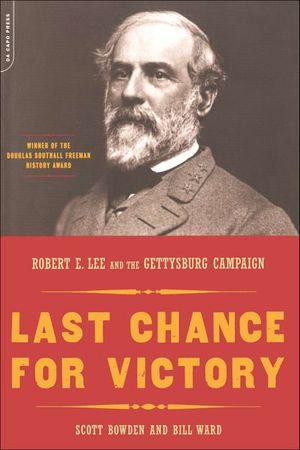

Last Chance For Victory


Published by Grand Central Publishing
A comprehensive analysis of the legendary general's strategies and tactics during one of the most important battles of the American Civil War.
Gettysburg is the most written about battle in American military history. Generations after nearly fifty,zero soldiers shed their blood there, serious and fundamental misunderstandings persist about Robert E. Lee's generalship during the campaign and battle. Last Chance for Victory: Robert E. Lee and the Gettysburg Campaign addresses these issues by studying Lee's choices before, during, and after the battle, the information he possessed at the time and each decision that was made, and why he acted as he did. Even options open to Lee that he did not act upon are carefully explored from the perspective of what Lee and his generals knew at the time.
Some of the issues addressed include: Whether Lee's orders to Jeb Stuart were discretionary and allowed him to conduct his raid around the Federal army; Why Richard Ewell did not attack Cemetery Hill as Lee ordered; Why Little Round Top was irrelevant to the July two fighting, a fact Lee clearly recognized; Why Cemetery Hill was the weakest point along the entire Federal line, and how close the Southerners came to capturing it; Why Lee decided to launch en echelon attack on July two, and why most historians have never understood what it was or how close it came to success.
Last Chance for Victory will be labeled heresy by some, blasphemy by others, all because its authors dare to call into question the dogmas of Gettysburg. But they do so carefully, using facts, logic, and reason to weave one of the most compelling and riveting military history books of our age.
BUY NOW FROM

COMMUNITY REVIEWS

