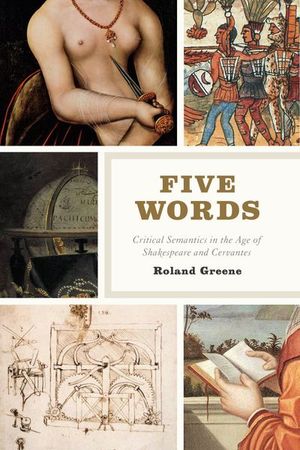

Five Words


Published by The University of Chicago Press
“The book’s greatest achievement . . . is in demonstrating how these five words together animate the worlds of Renaissance thought and culture.” —Comparative Literature Studies
Blood. Invention. Language. Resistance. World. Five ordinary words that do a great deal of conceptual work in everyday life and literature. In this original experiment in critical semantics, Roland Greene considers how these words changed over the course of the sixteenth century and what their changes indicate about broader forces in science, politics, and other disciplines.
Rather than analyzing works, careers, or histories, Greene discusses a broad swath of Renaissance and transatlantic literature—including Shakespeare, Cervantes, Camões, and Milton—in terms of the development of these five words. Aiming to shift the conversation around Renaissance literature from current approaches to riskier enterprises, Greene also proposes new methods that take advantage of digital resources like full-text databases but still depend on the interpreter to fashion ideas out of ordinary language. Five Words is an innovative and accessible book that points the field of literary studies in an exciting new direction.
“A brilliant exercise in cultural and linguistic criticism . . . Greene guides his readers through nuanced readings of a set of key terms that shape the emergence of modernity.” —Timothy Hampton, University of California, Berkeley
“[An] important discussion of five dynamical concepts, rooted in particular words, which underwent profound change in the age of Shakespeare and Cervantes.” —Gordon Teskey, Harvard University
“Five Words’s erudition and scope are indisputable as it draws on a vast store of sources ranging from Cicero to Philip Sidney, Antonio Viera to the Inca Garcilaso, not to mention Shakespeare and Cervantes.” —Comparative Drama
BUY NOW FROM

COMMUNITY REVIEWS

