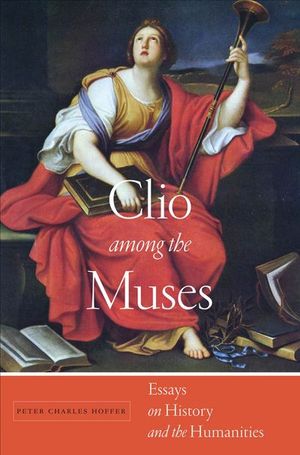

Clio among the Muses


Published by NYU Press
“A humane and learned, yet brief and accessible, meditation” on history’s relationship with the humanities (Daniel K. Richter, University of Pennsylvania).
“[A]n engaging book of enormous intellectual breadth and insight. Hoffer has read widely and made a strong case that history ‘should stand at the center of our quest for a truly humane spirit.’” —American Historical Review
History helps us understand change, provides clues to our own identity, and hones our moral sense. But history is not a stand-alone discipline. Indeed, its own history is incomplete without recognition of its debt to its companions in the humane and social sciences. In Clio among the Muses, noted historiographer Peter Charles Hoffer relates the story of this remarkable collaboration. Hoffer traces history’s complicated partnership with its coordinate disciplines of religion, philosophy, the social sciences, literature, biography, policy studies, and law. As in ancient days, when Clio was preeminent among the other eight muses, so today, the author argues that history can and should claim pride of place in the study of past human action and thought.
Intimate and irreverent at times, Clio among the Muses synthesizes a remarkable array of information. Clear and concise in its review of the companionship between history and its coordinate disciplines, fair-minded in its assessment of the contributions of history to other disciplines and these disciplines' contributions to history, Clio among the Muses will capture the attention of everyone who cares about the study of history. For as the author demonstrates, the study of history is something unique, ennobling, and necessary. One can live without religion, philosophy and the rest. One cannot exist without history. Rigorously documented throughout, the book offers a unique perspective on the craft of history.
“A wise, accessible book for the reader who wants to know why he likes History so much.” —Stanley N. Katz, Princeton University
“With broad learning, stout argument, and common sense, Peter Charles Hoffers newest book enters into a discussion about history’s place within the humanities. . . . [T]his is a lively, useful, thought-provoking, and distinctive book.” —The Journal of American History
BUY NOW FROM

COMMUNITY REVIEWS

