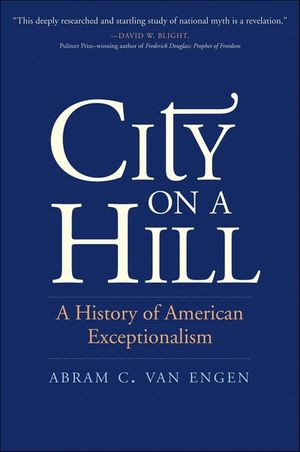

City on a Hill


Published by Yale University Press
A fresh, original history of America’s national narratives, told through the loss, recovery, and rise of one influential Puritan sermon from 1630 to the present day.
“Van Engen is an elegant, accessible writer, and this is a truly illuminating study of America.” —Washington Post
In this illuminating book, Abram Van Engen shows how the phrase “City on a Hill,” from a 1630 sermon by Massachusetts Bay governor John Winthrop, shaped the story of American exceptionalism in the twentieth century.
By tracing the history of Winthrop’s speech, its changing status throughout time, and its use in modern politics, Van Engen asks us to reevaluate our national narratives. He tells the story of curators, librarians, collectors, archivists, antiquarians, and often anonymous figures who emphasized the role of the Pilgrims and Puritans in American history, paving the way for the saving and sanctifying of a single sermon. This sermon’s rags-to-riches rise reveals the way national stories take shape and shows us how those tales continue to influence competing visions of the country—the many different meanings of America that emerge from its literary past.
“This deeply researched and startling study of national myth is a revelation.” —David W. Blight, Pulitzer Prize–winning author of Frederick Douglas: Prophet of Freedom
“An elegant piece of historical detective work . . .City on a Hill grasps a phrase you may think you understand—and then it turns that phrase to open the door to a huge room of rediscovered knowledge. . . . [A] wonderful archaeology of an American idea.” —The Atlantic
BUY NOW FROM

COMMUNITY REVIEWS

